8 Differences Between Led Lights And Led Grow Lights Explained
You’ve seen LED bulbs everywhere—ceiling fixtures, desk lamps, even that moody strip lighting under your gamer shelf. But then you look at “LED grow lights” and wonder: aren’t those just… LEDs with a gym membership? Short answer: not quite.
If you want plants that don’t flop over and give up, you need to know the differences. Let’s cut through the hype, skip the techno-babble, and lay out what actually matters when you’re choosing between standard LED lights and LED grow lights.
1) Spectrum: White Light vs Plant Food
Regular LED bulbs aim to make rooms look nice and colors look natural. They mostly focus on a balanced white spectrum tailored to human eyes.
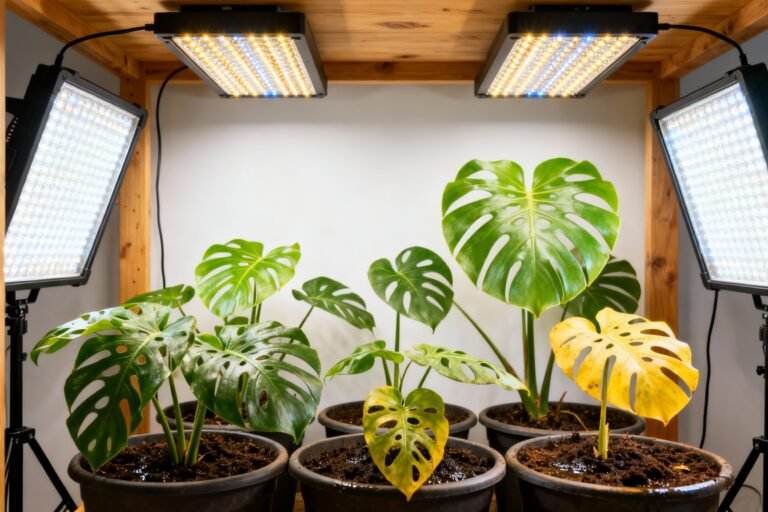
Grow lights? They feed plants with very specific wavelengths.
- Standard LEDs: Typically 2700K–6500K white light, optimized for how we perceive brightness and color.
- Grow LEDs: Tuned to plant biology—often heavy in blue (around 450 nm) for vegetative growth and red (around 660 nm) for flowering.
Full-Spectrum vs “Blurple”
Some grow lights offer “full-spectrum white” plus extra red/blue peaks—great if you want plants and a room you can actually stand to be in. The older “blurple” lights throw intense blue and red but make your space look like an alien rave.
Both can work; one is just easier on your eyeballs.
2) PAR and PPFD: The Metrics That Actually Matter
Lumens measure brightness to humans. Plants don’t care. They care about PAR (photosynthetically active radiation) and how much of it lands on their leaves (PPFD).
- PAR: The wavelengths plants use for photosynthesis (roughly 400–700 nm).
- PPFD: How many photons hit a square meter per second (measured in µmol/m²/s).
Grow lights publish PPFD maps to show intensity at different heights.
Standard LEDs rarely publish PPFD because they’re not designed for plants.
Real-World Targets
- Seedlings/clones: 100–300 µmol/m²/s
- Vegetative growth: 300–600 µmol/m²/s
- Flowering/fruiting: 600–900 µmol/m²/s
FYI, a normal desk lamp won’t get you anywhere near those numbers unless it’s basically touching the leaves, which… please don’t.
3) Efficiency: Lumens per Dollar vs Micromoles per Watt
Standard LED bulbs brag about lumens per watt. That’s great for reading, not for tomatoes. Grow lights focus on efficacy in µmol/J (micromoles per joule).
Modern quality grow fixtures hit 2.5 µmol/J or higher. If a grow light hides this number, IMO skip it.
- Household LED: Efficient for people-pleasing light.
- Grow LED: Efficient for leaf-pleasing photons.
4) Heat Management: Quiet Lifespan Insurance
LEDs hate heat. Too hot and they dim, shift spectrum, or die early.
Grow lights push high output for hours, so they need serious cooling.
- Standard LEDs: Basic heatsinks, sometimes enclosed fixtures. Fine for living rooms.
- Grow LEDs: Chunky heatsinks, improved thermal paths, and sometimes active cooling or smart thermal throttling.
Why It Matters
Better cooling means stable output, consistent spectrum, and longer life. Your plants don’t care about warranty paperwork, but your wallet does.
5) Form Factor and Coverage: Not All Light Lands Where You Want
You don’t just need bright—you need even.
Plants grow unevenly under spotty light. Grow fixtures spread photons across a canopy.
- Standard LEDs: Bulbs, downlights, panels. Light falls in a cone, often with hot spots and sharp falloff.
- Grow LEDs: Bar-style or quantum boards designed to uniformly cover a 2×2, 3×3, or 4×4 tent with even PPFD.
If you’re trying to light a whole tray, a normal bulb will leave corners sad and stretchy.
Not a vibe.
6) Controls and Spectral Tuning
You can dim many household LEDs, sure. But grow lights go further.
- Dimming: Good grow fixtures include smooth dimmers to fine-tune intensity for different growth stages.
- Spectrum switching: Some offer veg/bloom switches or extra deep red/UV channels for targeted phases.
- Smart control: Timers, sunrise/sunset ramps, and networked control for multiple fixtures.
Do you need all the bells and whistles? Not always.
But a dimmer alone saves seedlings from a photon beatdown.
7) Build Quality and Safety
Grow lights run long hours in humid, sometimes hot spaces. That’s a recipe for corrosion and short circuits if you cheap out.
- Ingress ratings: Better grow fixtures advertise moisture resistance (e.g., IP65 rated).
- Drivers and certifications: Look for well-known drivers, thermal protections, and safety marks.
- Cables and connectors: Robust, heat-resistant, and properly grounded.
Standard LEDs weren’t built for steamy grow tents. Unless you enjoy tripping breakers, choose accordingly.
8) Cost vs Outcome: False Economies Are Real
Yes, grow lights cost more upfront.
But they deliver higher PPFD, better uniformity, and spectra that actually grow things. A pile of cheap bulbs might match the price, but rarely the results. Consider this:
- Yield per watt: Good grow lights produce more biomass per watt than ad-hoc bulb setups.
- Longevity: Proper thermal design and quality components last longer and hold output.
- Time saved: Faster growth cycles and fewer plant issues pay you back.
IMO, if you care about consistent harvests, go purpose-built.
When a Regular LED Can Work (and When It Won’t)
Can you keep a pothos or snake plant alive under a standard LED? Yep.
Many low-light houseplants just need a boost. But for vegetables, herbs, seedlings, or anything that flowers or fruits, a true grow light makes a noticeable difference.
- Use a standard LED: Decorative plants, short-term emergency light, or supplementing a bright window.
- Use a grow light: Seed starting, leafy greens, herbs, peppers, tomatoes, flowering houseplants, or full indoor grows.
Quick Buying Tips
- Match fixture size to your grow area (2×2, 3×3, etc.).
- Check efficacy (aim for 2.3–3.0 µmol/J).
- Look for PPFD maps at your intended hanging height.
- Favor full-spectrum white with added red for versatility.
- Get a dimmer. Your seedlings will thank you.
Common Myths, Debunked
“More watts = better growth.”
Not necessarily.
Watts tell you power draw, not usable light. Efficacy and distribution matter more.
“Plants only need red and blue.”
They use red and blue heavily, but green penetrates deeper into the canopy and boosts photosynthesis too. Balanced full-spectrum often outperforms pure blurple in real grows.
“Any bright light will do.”
If “do” means leggy stems and slow growth, sure.
Plants need targeted intensity and spectrum, not just brightness.
“Grow lights must look purple.”
Nope. Many top-tier fixtures use white-based spectra with supplemental reds. Your plants thrive, and your retinas relax.
FAQ
Can I grow herbs on my kitchen counter with regular LEDs?
You can, but growth will be slower and leggier.
A small, full-spectrum grow light with a dimmer will keep basil bushy and flavorful. If counter space matters, choose a slim bar-style fixture.
What color temperature works best if I only have standard LEDs?
Go with 4000K–6500K “cool white.” It leans blue, which helps vegetative growth. Add more fixtures or bring them closer to boost intensity, but watch heat and leaf burn.
How close should I hang a grow light?
Depends on the model and dimmer setting.
Start at 18–24 inches for seedlings on low power, 12–18 inches for veg, and adjust using a PPFD app or the manufacturer’s chart. If leaves taco or bleach, back off or dim down.
Do I need UV and IR for better yields?
Not mandatory. UV and far-red can enhance certain traits and flowering responses, but they’re the icing, not the cake.
Prioritize adequate PPFD, uniformity, and a solid full-spectrum first.
Why do some grow lights list lumens and not PPFD?
Marketing, usually. Lumens target human vision. For plants, ask for PPFD maps and efficacy (µmol/J).
If they don’t share them, treat it as a red flag.
Will grow lights raise my room temperature?
A bit, yes. Even efficient LEDs release heat. Good ventilation or a small fan keeps canopy temps in the happy zone.
The upside: less heat than older HID or fluorescent setups.
Conclusion
Regular LEDs make rooms look great. LED grow lights make plants grow great. That’s the core difference.
If you want lush greens, sturdy stems, and actual harvests, choose a fixture built for plant biology—solid spectrum, high PPFD, good cooling, and even coverage. Your plants won’t write you a thank-you note, but the results speak for themselves. And FYI, once you see the difference, you won’t go back.