11 Essential Monstera Light Requirements To Keep Plants Thriving
Monsteras look dramatic, but they’re not divas—just a little particular about their lighting. Nail the light, and you’ll get those iconic, holey leaves that make strangers ask, “Is that plant real?” Miss the mark, and you’ll get leggy stems and sad, droopy vibes. Let’s skip the fluff and dial in exactly what your Monstera wants from the sun (and your windows).
Bright, Indirect Light Is the Gold Standard
Your Monstera thrives in bright, indirect light.
Think of it like a cozy shade under a tree—plenty of daylight, no harsh sunbeams frying leaves.
- Place 3–5 feet back from a bright window.
- Use sheer curtains to soften strong sun.
- Watch the leaf color: healthy green = good light, dull and stretched = not enough.
What does “indirect” actually mean?
If a shadow looks blurry and soft, you’re in the right zone. Crisp, sharp shadows scream direct sun—move it back.
Windows Matter: Match Exposure to Your Plant
Different windows create different lighting stories. Choose the one that fits your Monstera’s vibe.
- East-facing: Ideal.
Gentle morning sun plus bright daylight.
- North-facing: Good if unobstructed; otherwise may need a grow light.
- West-facing: Works with a sheer—afternoon sun can scorch.
- South-facing: Brightest. Place farther back or use diffusing curtains.
Apartment cave? No problem.
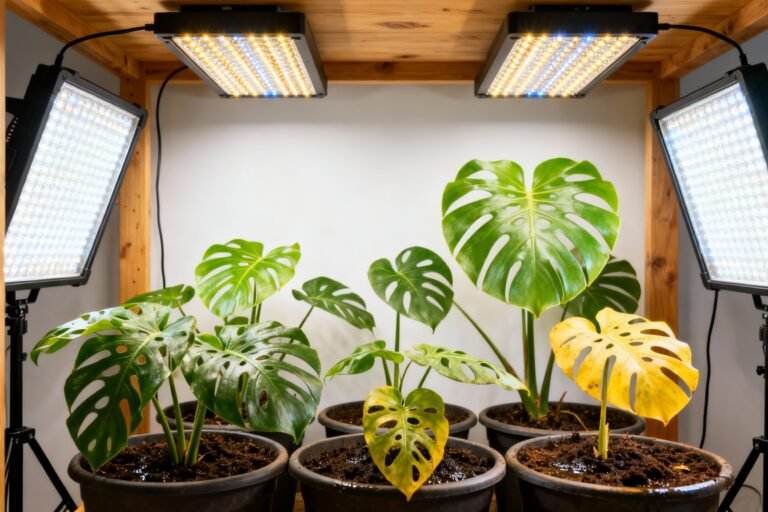
If your place feels like a cozy dungeon, use a full-spectrum LED for 8–12 hours a day.
Keep it 12–24 inches above the plant.
11 Essential Monstera Light Requirements
Let’s rapid-fire the must-knows. Screenshot this if you want a mini checklist.
- Bright, indirect light for 6–8 hours daily.
- Avoid direct midday sun to prevent leaf scorch.
- Rotate the pot 90° weekly for even growth and balanced fenestrations.
- Use sheer curtains on west/south windows to diffuse light.
- Supplement with grow lights in low-light rooms (8–12 hours).
- Keep lights at the right distance: 12–24 inches from LEDs.
- Watch for leggy growth—it screams “I need more light.”
- Protect from drafts and hot glass: leaves burn against sunny windows.
- Clean leaves monthly so dust doesn’t block photons (yes, really).
- Adjust seasonally: move closer in winter, back in summer.
- Remember variety matters: variegated Monsteras need a bit more light.
How to Read Your Monstera’s Light Signals
Monsteras talk with their leaves. Not literally, but close.
- Leggy, long internodes: Not enough light.
Move closer to a window.
- Small, solid leaves with no holes: Increase light gradually.
- Yellow or crispy patches: Too much direct sun—diffuse or move back.
- Droopy leaves: Could be low light, but also check watering. FYI, low light slows drying.
Fenestrations and light
Those gorgeous holes and splits develop when the plant gets enough energy. More light (not scorching) usually means more fenestrations.
No splits? Your Monstera might be whispering, “Turn on the lamp.”
Grow Lights Without the Guesswork
You don’t need a science degree to use grow lights, promise. Keep it simple.
- Type: Full-spectrum LED or “daylight” LED (5000–6500K).
- Duration: 8–12 hours daily.
Use a timer so you don’t forget.
- Distance: 12–24 inches above or beside the plant.
- Signs it’s too close: Faded patches, curled edges, or crispy tips.
Light schedule hack
Run lights during your day so you enjoy the bright space too. Plants love routine; so do humans who don’t want to fiddle with switches.
Sunlight Through the Seasons
The sun shifts, and your Monstera notices. Adjust or watch it sulk.
- Winter: Move it closer to the window, extend light hours, and dust leaves.
- Spring: Increase light gradually to avoid shock.
New growth pops here.
- Summer: Pull back from scorching windows. Sheers are your best friend.
- Fall: Start nudging it toward brighter spots as days shorten.
Common Light Mistakes (And Easy Fixes)
Let’s dodge the usual oopsies.
- Parking it in a dark corner and expecting glossy rainforest vibes. Solution: window + grow light combo.
- Direct sun through glass at noon. Solution: sheer curtain or move back 2–4 feet.
- Never rotating the plant. Solution: quarter-turn weekly; IMO, set a calendar reminder.
- Ignoring dust. Solution: wipe leaves with damp cloth monthly.
It’s plant skincare.
- Overcompensating with heat lamps. Please don’t. You want light, not a toaster.
Variegated Monstera note
White variegation can’t photosynthesize. These plants need brighter indirect light to make up for lost green.
Too little light = reversion or weak growth. Too much direct sun = crispy white patches. It’s a balance beam.
Pairing Light With Everything Else
Light affects how often you water, fertilize, and repot.
It’s the puppet master.
- More light = faster growth = more frequent watering and feeding.
- Less light = slower drying = risk of overwatering. Check soil before watering, always.
- Support poles help in brighter spots—more energy means more aerial roots and climbing.
FAQs
Can Monsteras handle direct sun at all?
Brief morning sun from an east window usually works fine. Avoid harsh midday or late afternoon sun through glass, which can scorch leaves.
If you see pale patches or crispy edges, you’ve gone too far—pull it back or add a sheer.
How do I know if my grow light is strong enough?
Watch the plant. If internodes stretch and leaves stay small, increase duration or lower the light slightly. FYI, most Monsteras look great with a 20–40W full-spectrum LED run for 8–12 hours at 12–24 inches.
Why is my Monstera not getting splits?
Insufficient light tops the list.
Also consider plant maturity, nutrition, and support for climbing. Improve light for a few weeks and you’ll often see larger, more fenestrated leaves in the next growth cycle.
Is a north-facing window useless?
Not useless—just gentler. If it’s unobstructed and bright, your Monstera can do fine.
If it feels gloomy, add a grow light for a few hours daily and call it a day.
Do Monsteras like being outdoors?
They love bright shade outdoors in warm weather. Keep them under a covered patio or tree canopy—no direct afternoon sun. Acclimate slowly over a week to avoid leaf shock.
How far should I place my Monstera from a south-facing window?
Start 4–6 feet back with a sheer curtain.
If leaves look deep green and growth stays compact, you’re golden. If you see pale patches, increase the distance or double up the sheer.
Conclusion
Get the light right, and your Monstera will basically pose for photos on its own. Aim for bright, indirect light, adjust with seasons, rotate weekly, and don’t be shy about a grow light.
Do those simple things and, IMO, you’ll get bigger leaves, better splits, and a plant that looks like it skipped leg day forever.